 Talk to our team
Making complex institutional records readable, structured and ready for the AI economy.
Model weights: https://huggingface.co/AminiTech/Soma-1X-lite
Today, we’re introducing Soma-1X Lite, a compact 2-billion-parameter vision-language model for document intelligence. Soma-1X Lite transforms documents into structured, machine-readable representations, preserving text, document layout, semantic elements, and spatial information.
Built on expertise stemming from processing millions of government records, Soma-1X Lite combines competitive document-understanding performance with efficient inference and the flexibility to run on private infrastructure.
We developed Soma-1X Lite around a simple principle: capable document intelligence should be accessible to institutions without requiring frontier-scale infrastructure or sending sensitive records to external services.
Highlights
- Structured document understanding. A single vision-language model extracts content, semantic blocks, bounding boxes and reading order, with tables represented in HTML and mathematical expressions in LaTeX.
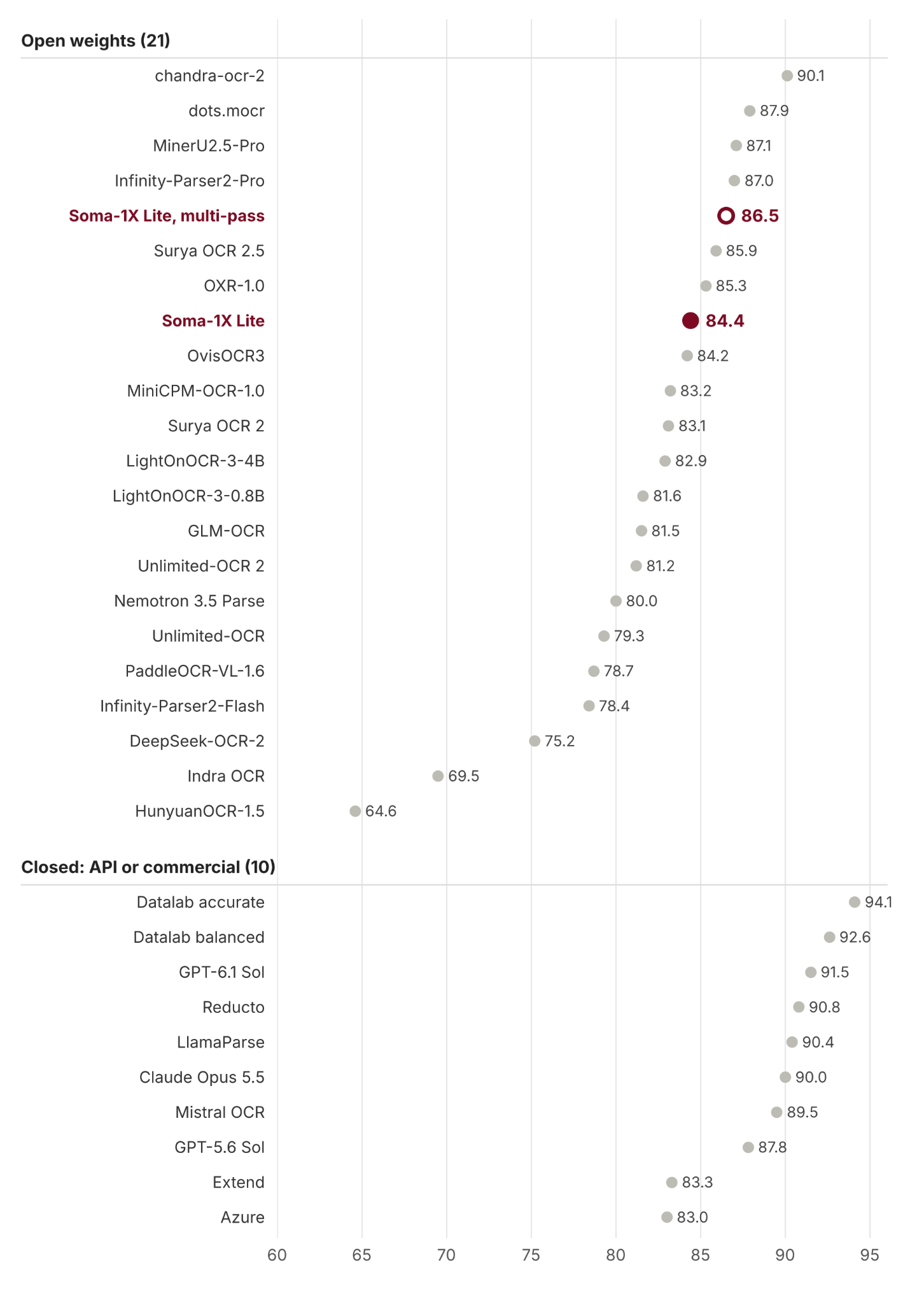
- Competitive public benchmarks. Soma-1X Lite scores 84.7 on olmOCR-Bench and 84.37 on OmniParse-Bench (OPB) in our reported evaluations. With a multi-pass inference harness that selectively reprocesses challenging document regions, the OPB score increases to 86.53.
- Multilingual transcription. Delivers strong transcription performance across widely spoken languages such as English, French and Spanish, with particular strengths in underrepresented languages. Soma-1X Lite achieves the lowest average character error rate among five evaluated open models on held-out documents spanning ten African languages, including Swahili, Yoruba, Hausa and Wolof, while accurately preserving language-specific characters and diacritics.
- Efficient inference. Soma-1X Lite can process up to 15,000 pages per hour on a single NVIDIA RTX PRO 6000 GPU, with an estimated GPU compute cost of $0.22 per 1,000 pages.
- Built on real-world experience. Shaped by our experience digitising millions of government records and informed by the expertise of domain partners such as ROAD.
Lessons from real-world deployments
Over the past year, Amini has processed millions of government records in private, sovereign environments, from handwritten police diaries and historical cabinet papers in Barbados to geological maps and mineral resource records in Botswana.
Working with these collections has revealed some of the most persistent challenges in document parsing: inconsistent handwriting, complex layouts and tables, handwritten annotations, degraded scans and documents in underrepresented languages.
In institutional settings, even small errors can have significant consequences. A missing digit, a misread name or an incorrectly reconstructed table can change the meaning of a record and affect how that information is interpreted or used.
These challenges have shaped how we train, evaluate and refine Soma-1X Lite, with a focus on the kinds of errors that matter most in real-world institutional settings.
Training Soma-1X Lite
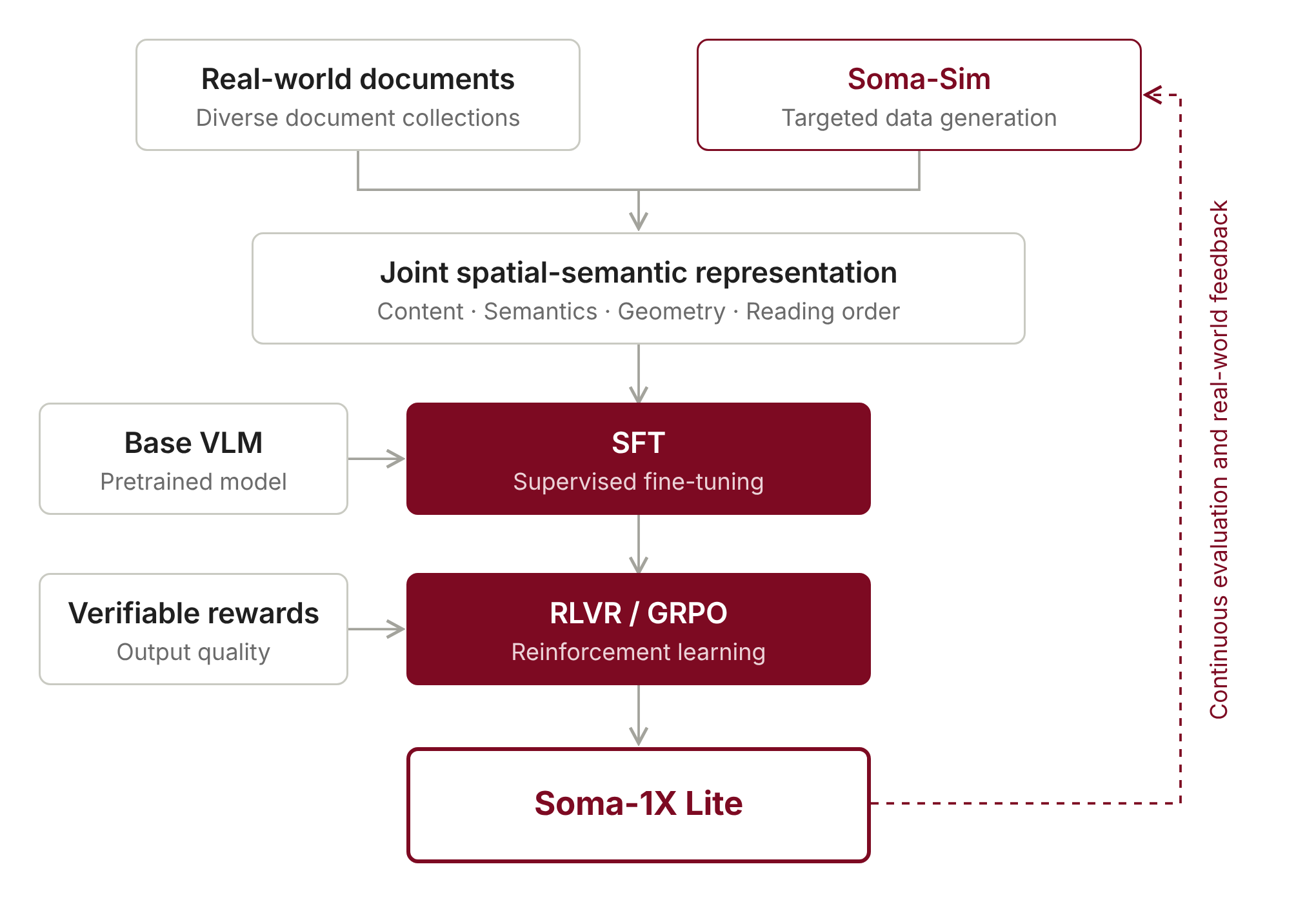
Soma-1X Lite is developed through a multi-stage training process combining supervised fine-tuning (SFT) and reinforcement learning with verifiable rewards (RLVR). Our training approach emphasises transcription fidelity, structural accuracy and spatial understanding.
Joint spatial-semantic representation
Document understanding requires more than recognising text. It involves identifying the semantic roles of document elements, their spatial positions and the structural relationships that determine how information is organised.
Soma-1X Lite jointly models these properties within a unified document representation. Each document element is associated with a semantic label, spatial coordinates and its corresponding content, while preserving reading order. Tables are represented in HTML and mathematical expressions in LaTeX.
This approach enables the model to perform transcription, layout understanding and structural reconstruction within a single generation task.
Training data and Soma-Sim
To complement real-world document collections, we developed Soma-Sim, a programmable document generation engine that enables the controlled generation of diverse document layouts, multilingual content, complex tables, handwritten elements and varying document quality conditions, with precise ground-truth annotations.
Soma-Sim enables us to systematically vary document characteristics, isolate specific challenges and construct targeted training examples. This is particularly valuable for complex document structures and challenging visual conditions, where accurately annotated training data can be difficult to obtain at scale.
Through Soma-Sim, failure modes identified during model evaluations and real-world deployments inform the generation of targeted training data.
Supervised fine-tuning
During supervised fine-tuning, the model learns to generate structured document representations across diverse document types, layouts and languages. This stage establishes the model’s ability to faithfully transcribe content, identify semantic elements, localise document regions and reconstruct complex document structures.
Reinforcement learning with verifiable rewards
Following supervised fine-tuning, we further optimise the model using Group Relative Policy Optimisation (GRPO).
Document parsing provides a rich environment for reinforcement learning, as many properties of a generated document representation can be objectively evaluated against ground truth. We leverage these verifiable properties to design rewards that assess model outputs across measurable dimensions of document parsing quality, including transcription fidelity and structural accuracy.
Together, these components form the foundation of our continuous learning engine, where rigorous evaluation and real-world feedback inform targeted data generation, model training and subsequent improvements.
Benchmark performance
We evaluated Soma-1X Lite on two public document-understanding benchmarks, olmOCR-Bench and OmniParse-Bench (OPB), alongside internal evaluations focused on multilingual transcription and inference efficiency.
These evaluations assess the model’s ability to accurately recognize document content, preserve complex structures and process diverse document types.
olmOCR-Bench
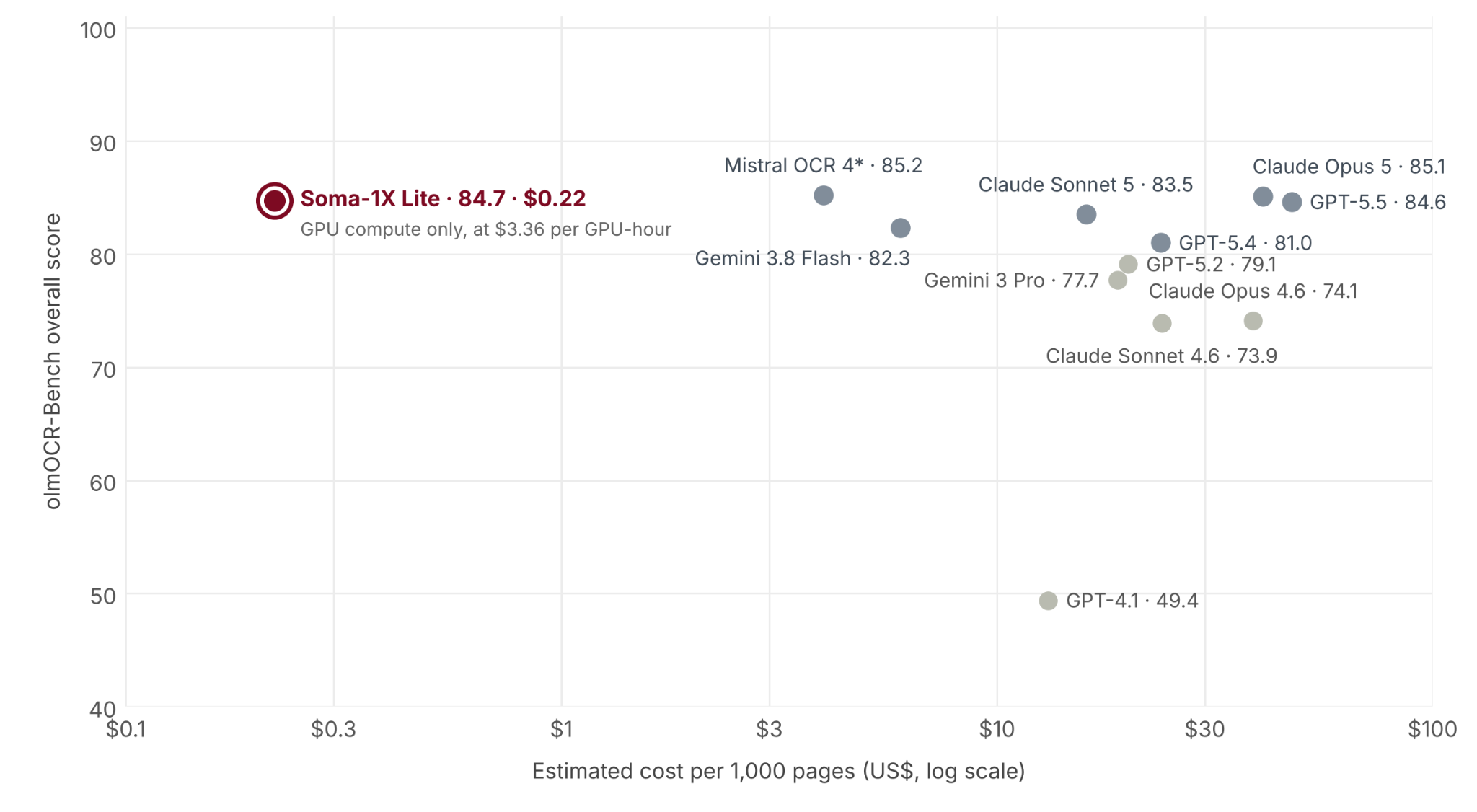
Soma-1X Lite scores 84.7 overall on olmOCR-Bench, which evaluates document transcription across tables, mathematical content, multi-column layouts, historical scans, and other challenging document types.
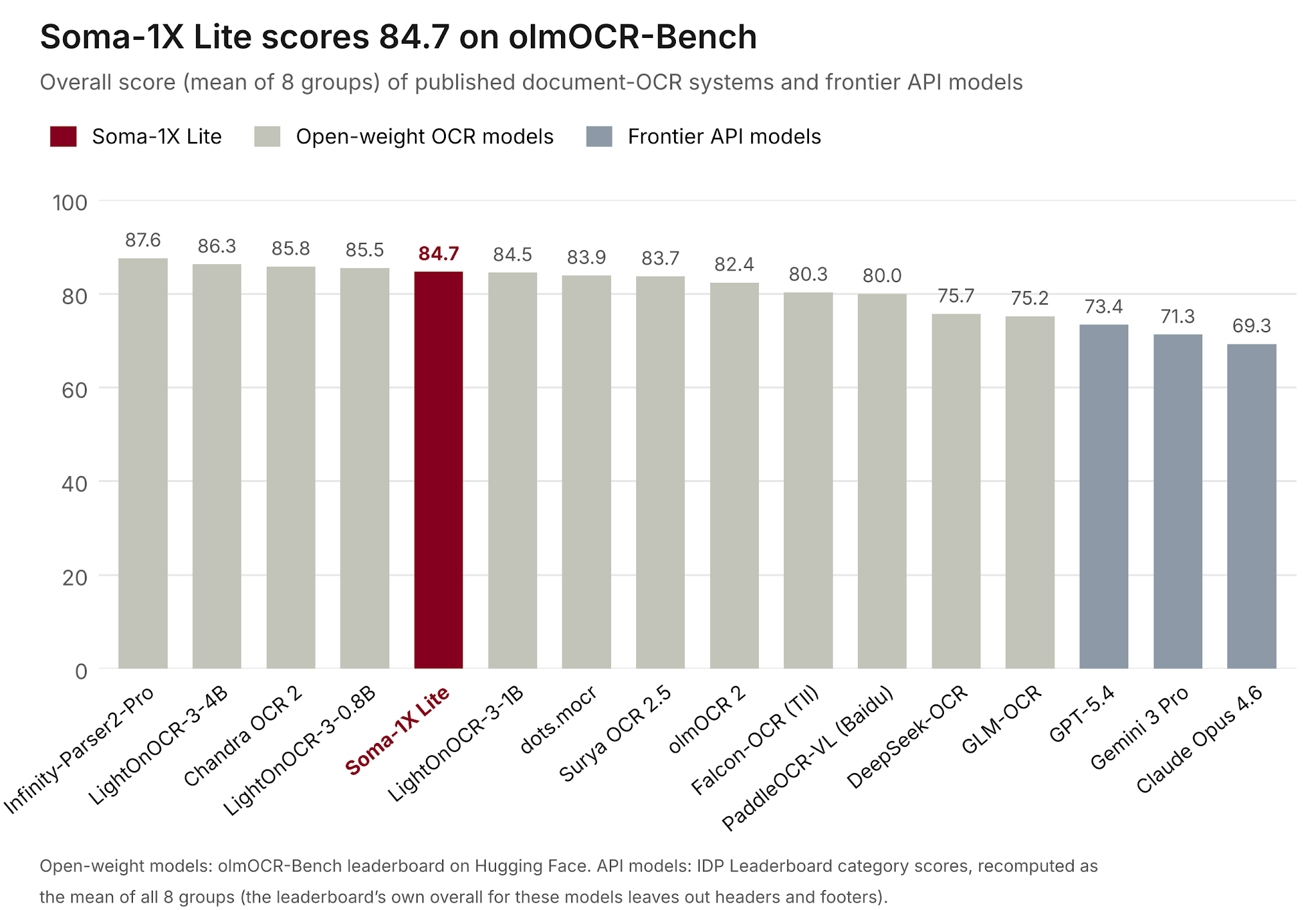
Sources: Open-weight model scores are sourced from the olmOCR-Bench leaderboard on Hugging Face. API model scores are drawn from published evaluations by Unsiloed AI (GPT-5.5), Interfaze (Claude Sonnet 5 and Gemini 3.8 Flash), and Nanonets IDP Leaderboard (GPT-5.4, Gemini 3 Pro and Claude Opus 4.6).
OmniParse-Bench (OPB)
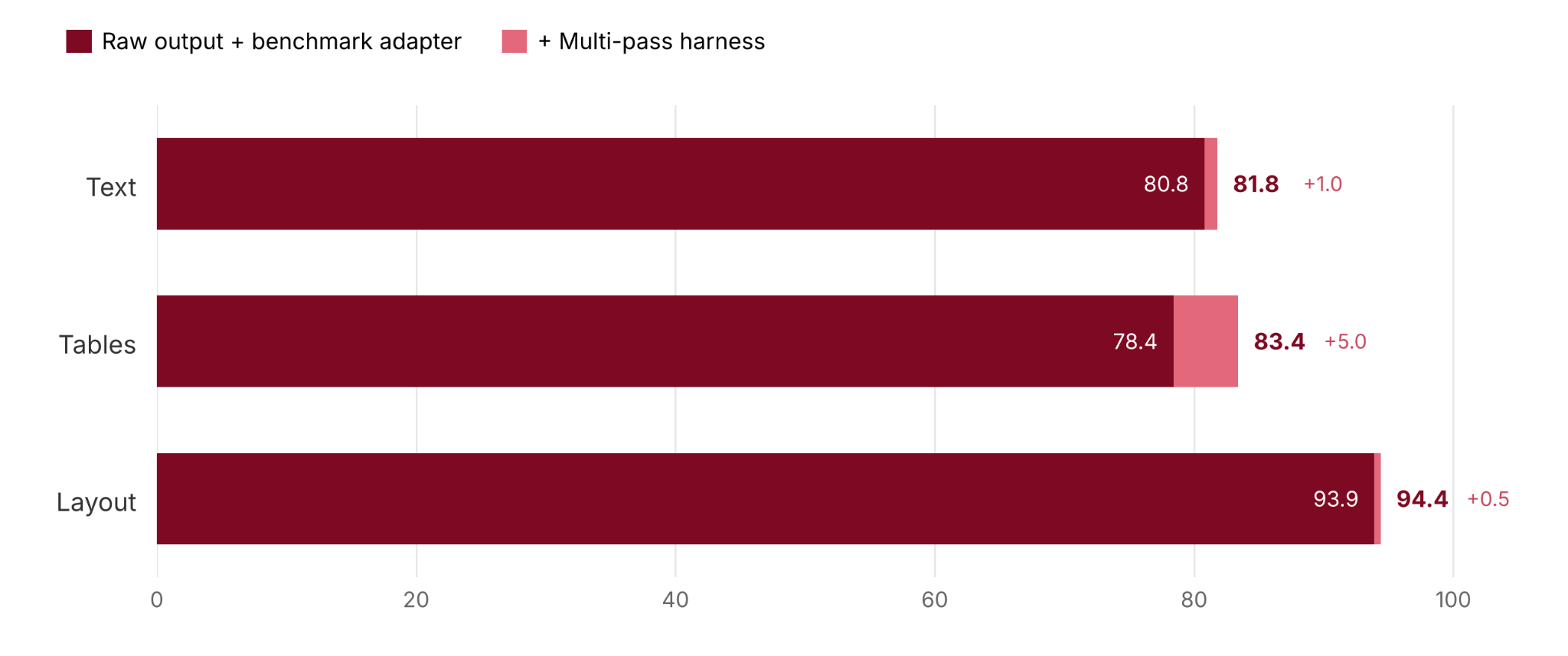
Soma-1X Lite scores 84.37 overall on OmniParse-Bench (OPB), which evaluates document parsing across text, table structure, and layout understanding. With a multi-pass inference harness that selectively reprocesses challenging document regions, including complex tables and rotated pages, the overall score increases to 86.53.
African-language transcription
An important focus in developing Soma-1X Lite has been improving transcription across underrepresented languages, particularly those with characters and diacritics that existing document-parsing models may struggle to preserve.
For example, Yoruba uses dotted letters such as ẹ, ọ and ṣ; Hausa uses hooked letters including ɓ, ɗ and ƙ; and Lingala uses open vowels ɛ and ɔ. Accurately preserving these characters is essential for faithful document transcription.
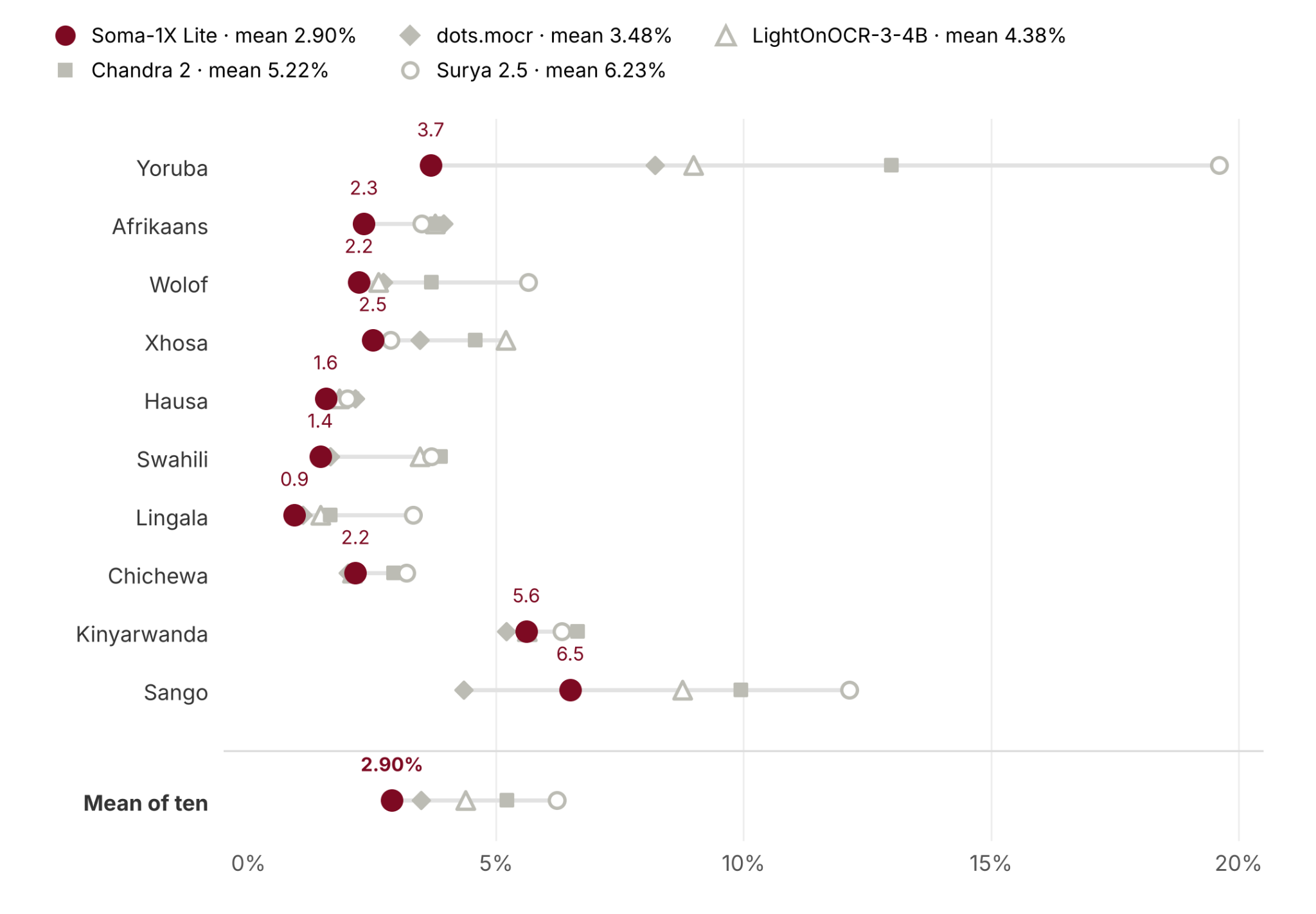
We evaluated Soma-1X Lite alongside four other open-weight document-parsing models on an internal test set of spanning ten African languages.
Soma-1X Lite achieved the lowest mean character error rate of 2.90%, recording the best performance among the evaluated models in seven of the ten languages.
Beyond overall transcription accuracy, we evaluated how reliably each model preserves language-specific characters.
Table 1. Percentage of language-specific characters correctly retained in the evaluated pages. Higher is better.
These results highlight the importance of evaluating transcription beyond aggregate error rates. A model can achieve competitive overall accuracy while systematically losing characters that carry important linguistic distinctions.
Inference efficiency at scale
For institutions processing millions of documents, inference efficiency is as important as model accuracy. Soma-1X Lite’s compact architecture makes large-scale document parsing computationally and economically practical.
In our benchmark runs, Soma-1X Lite can process up to 15,000 pages per hour on a single NVIDIA RTX PRO 6000 GPU. Based on an on-demand cloud compute rate of approximately $3.36 per hour (AWS EC2 G7e pricing), this corresponds to approximately $0.22 per 1,000 pages, or $224 in compute costs to process one million pages.
This combination of competitive accuracy and efficient inference makes large-scale document digitisation practical on infrastructure that institutions can own and control.
Soma-1X Lite in action
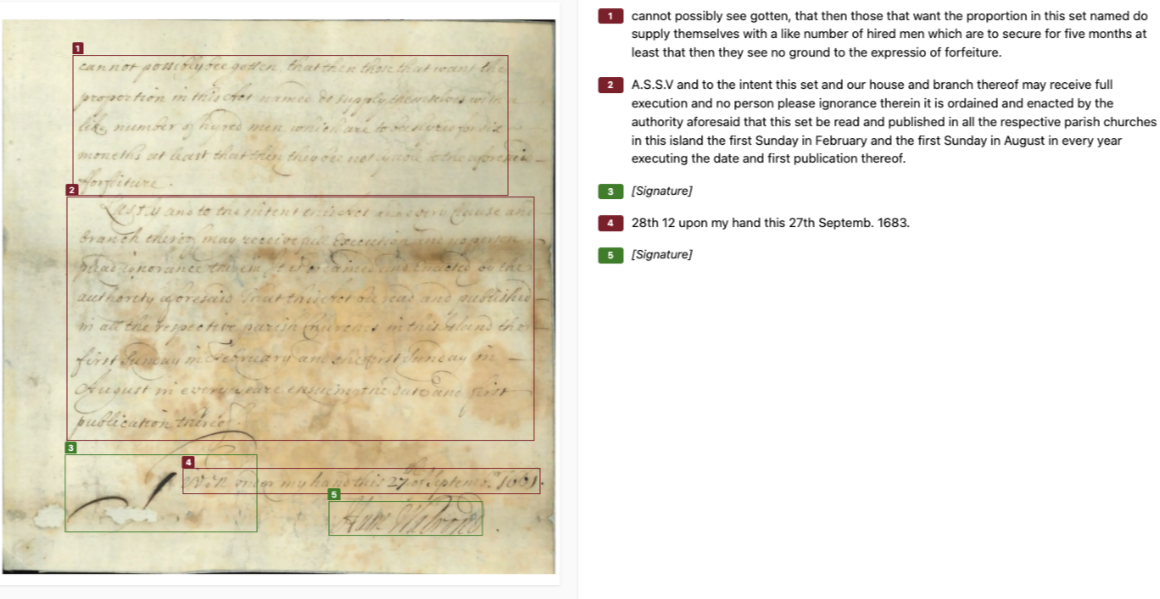
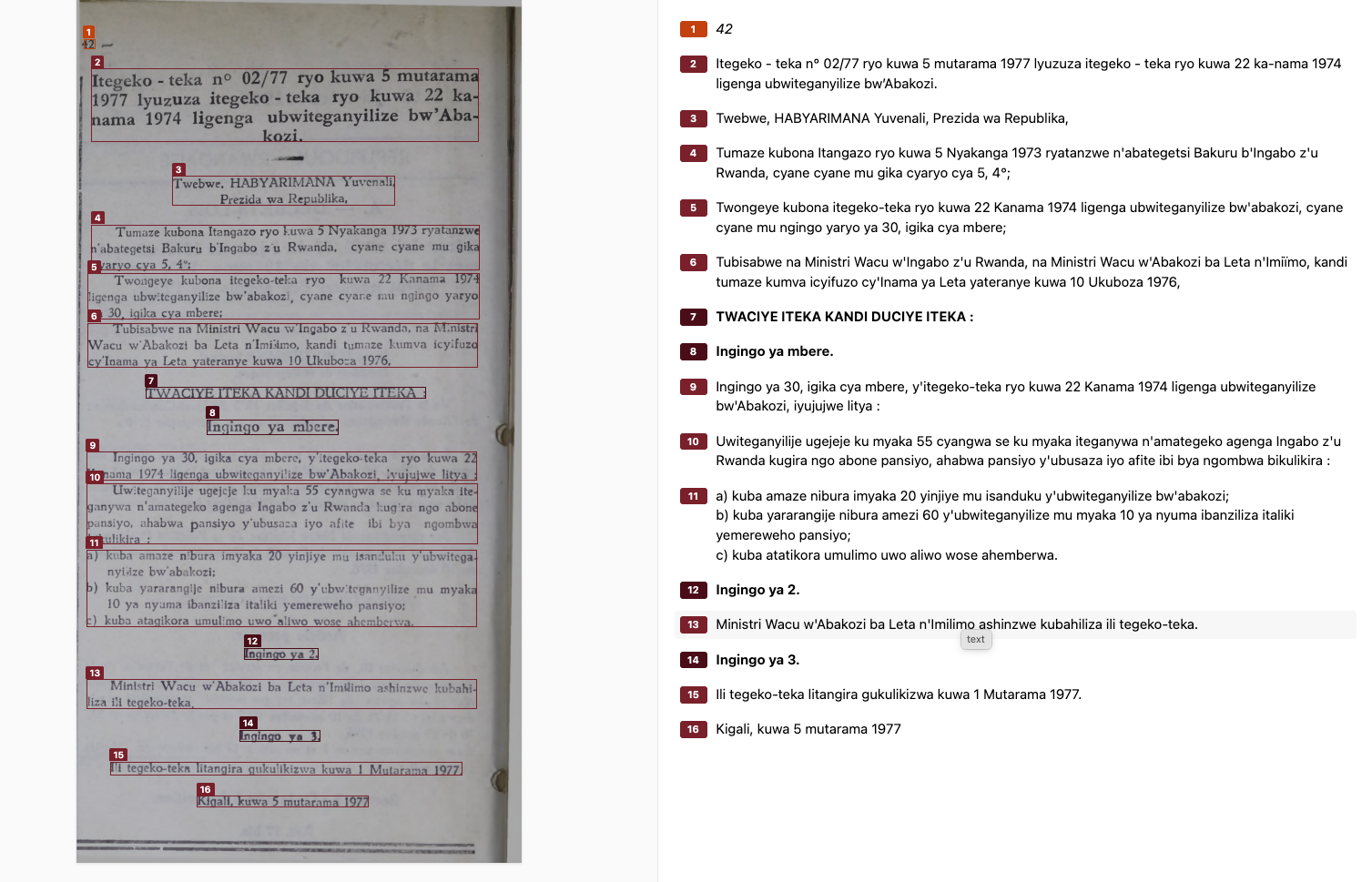
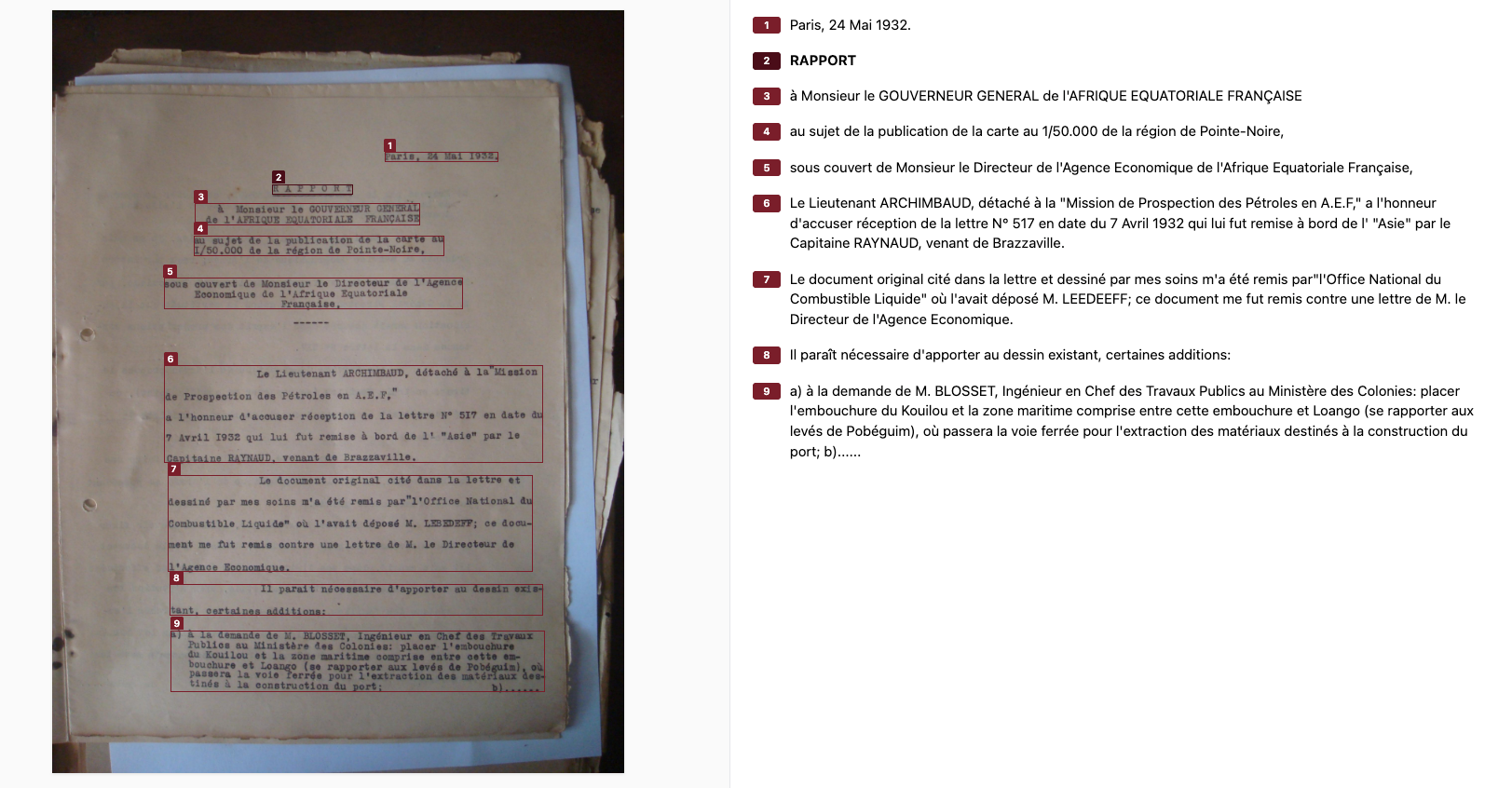
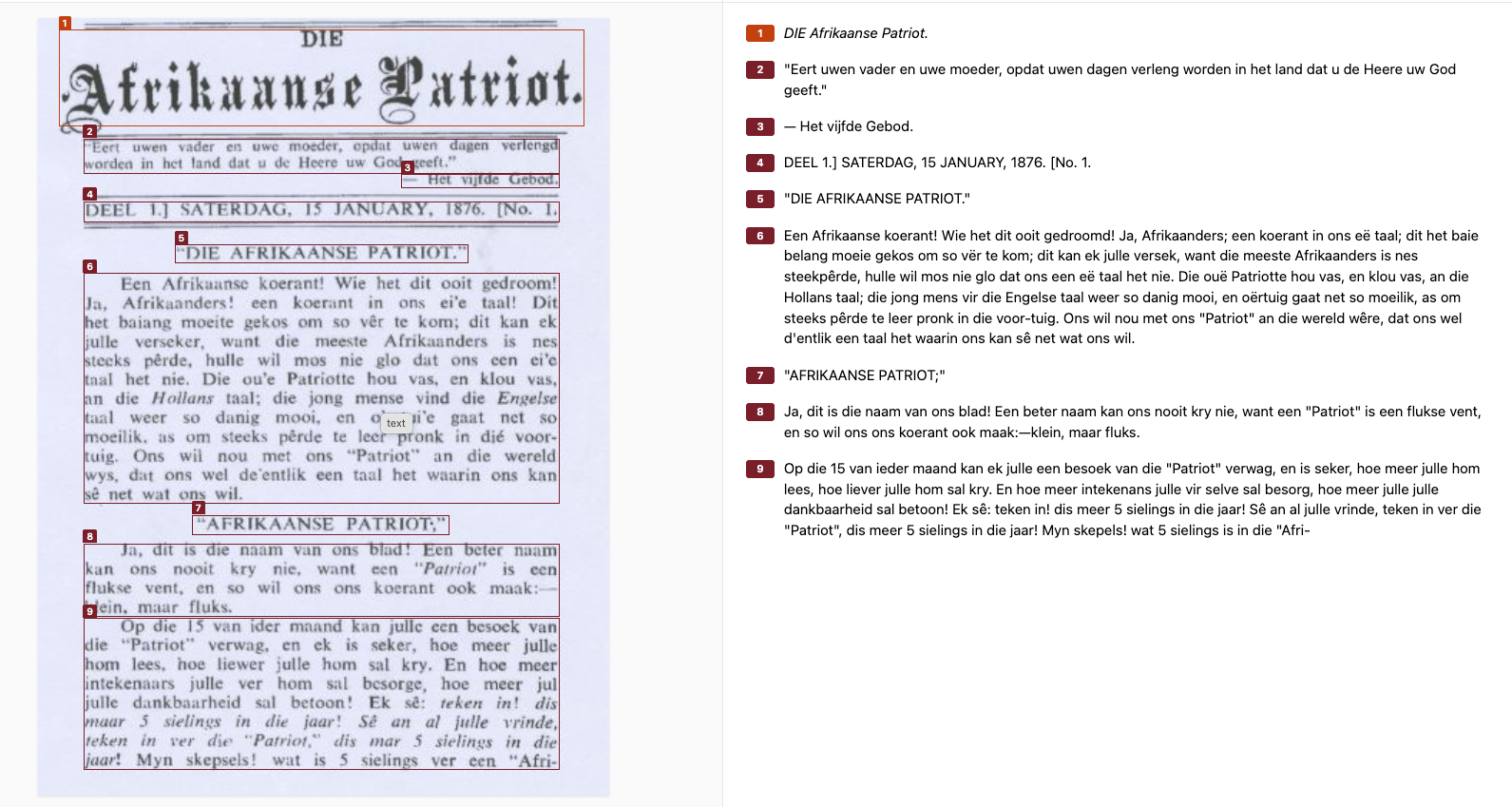
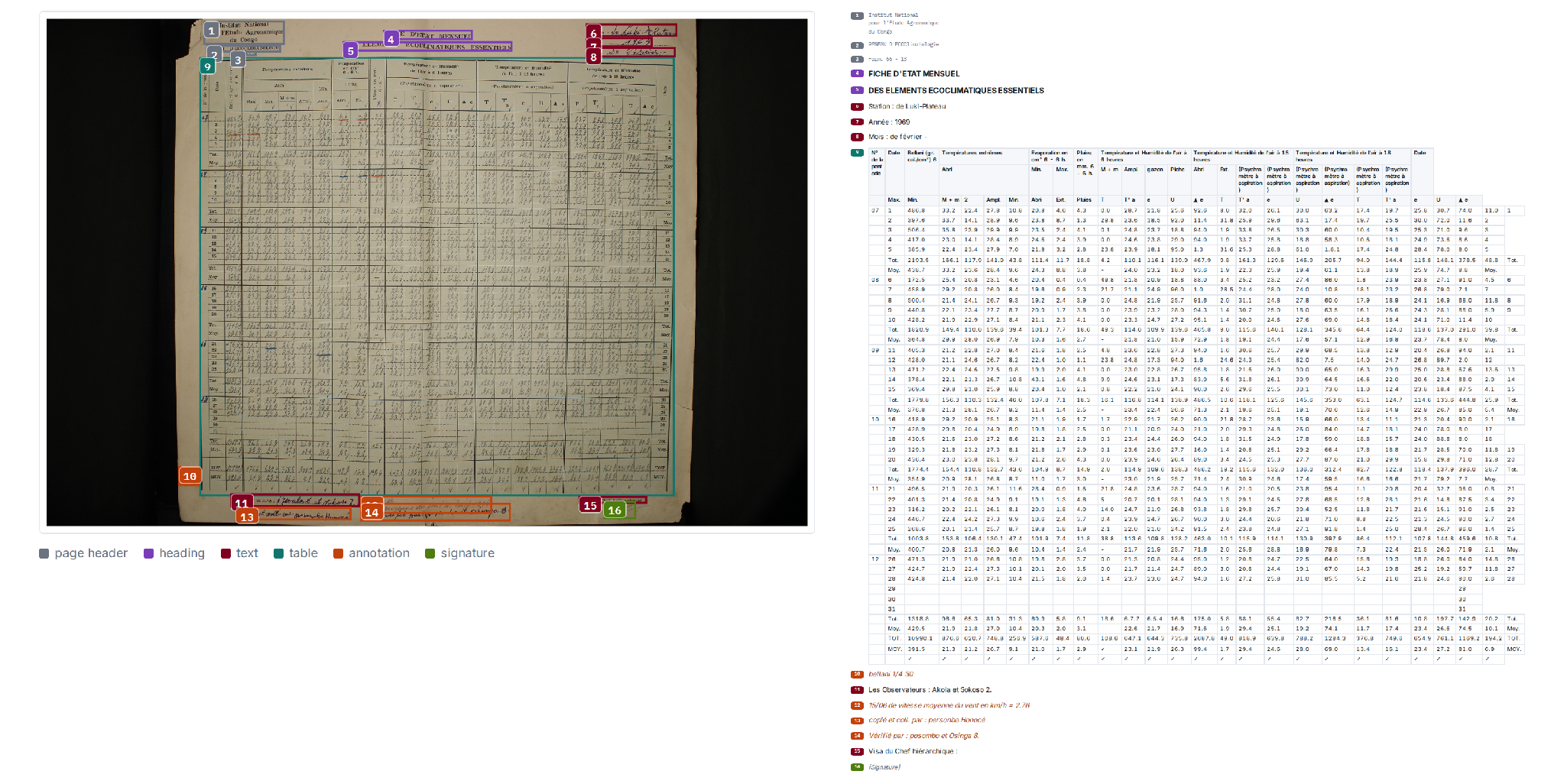
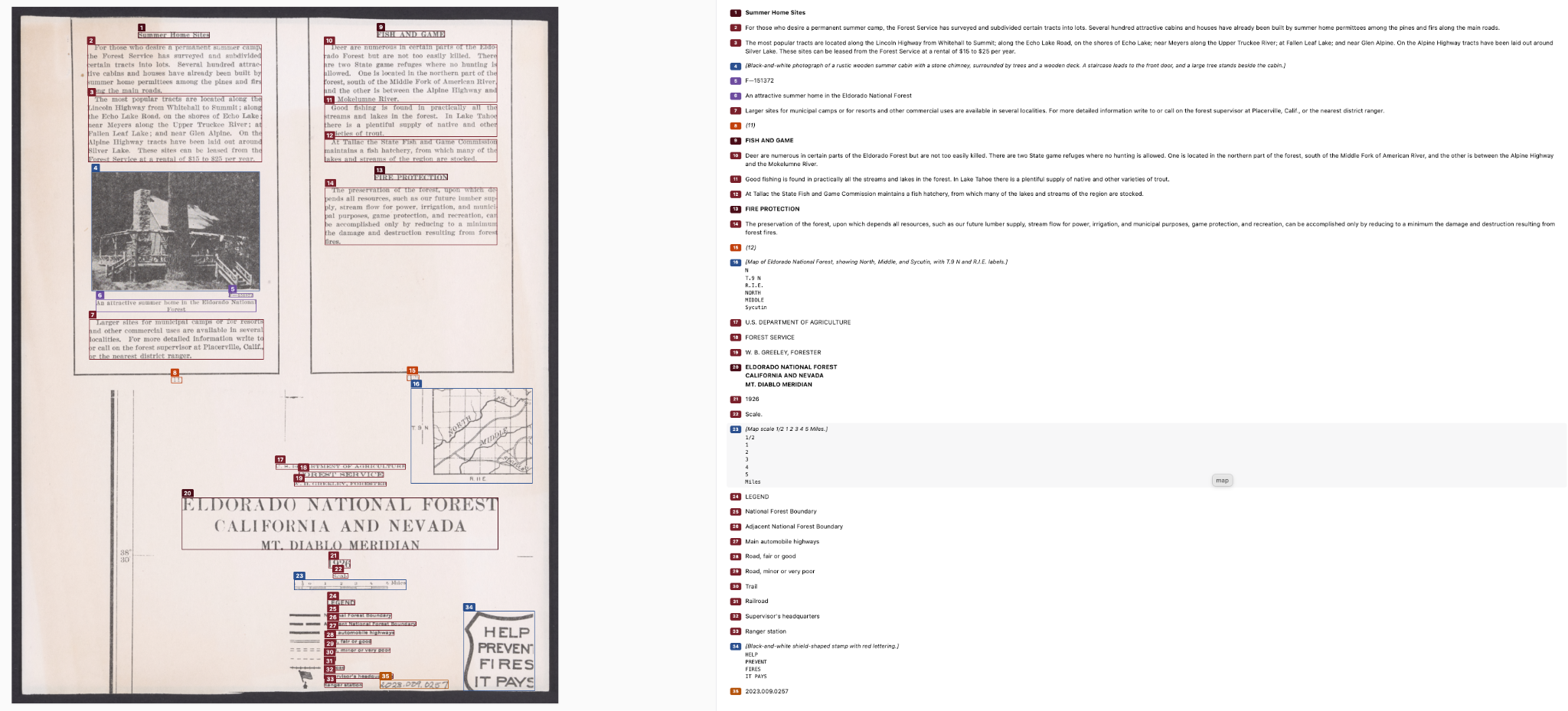
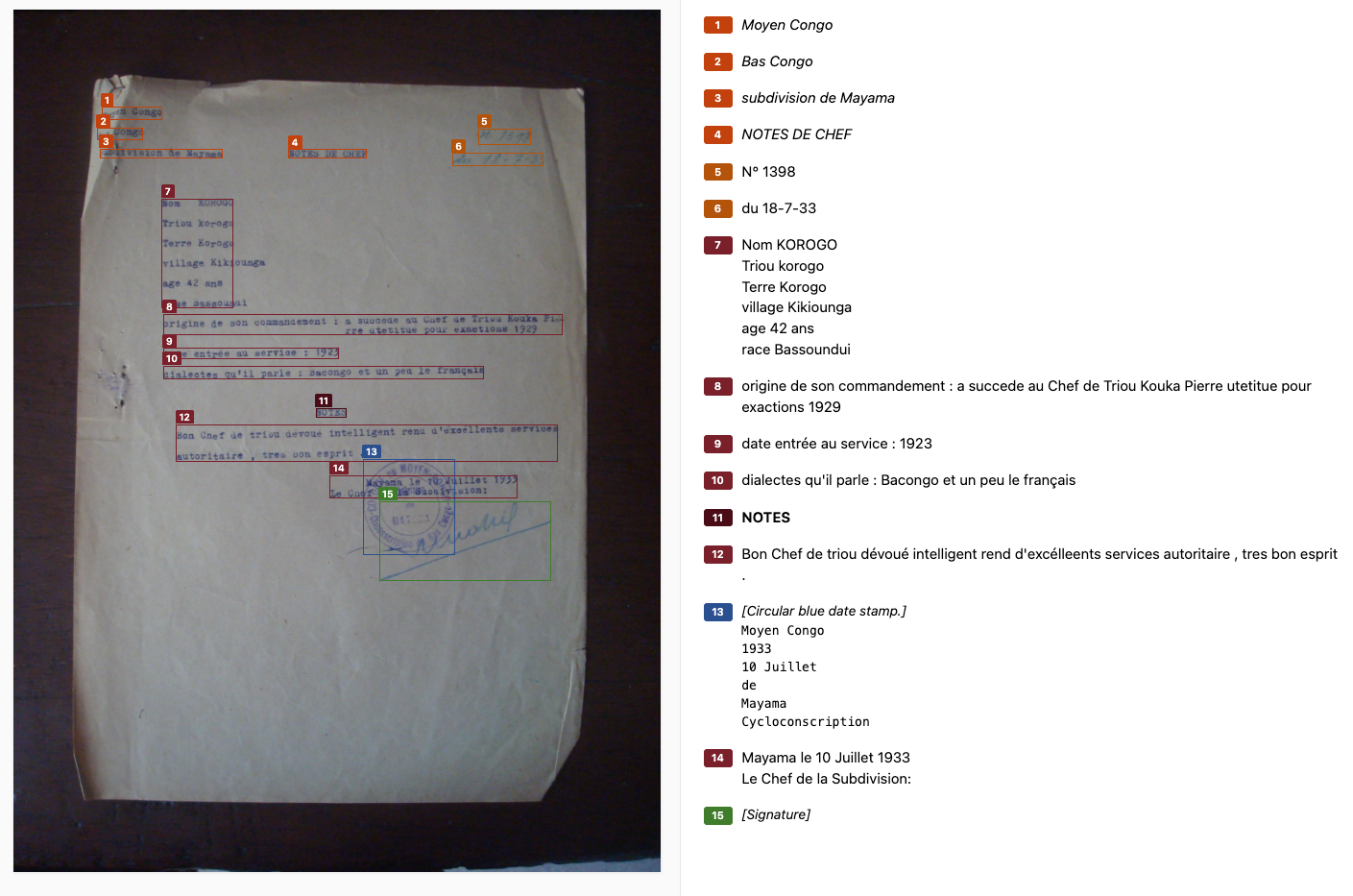
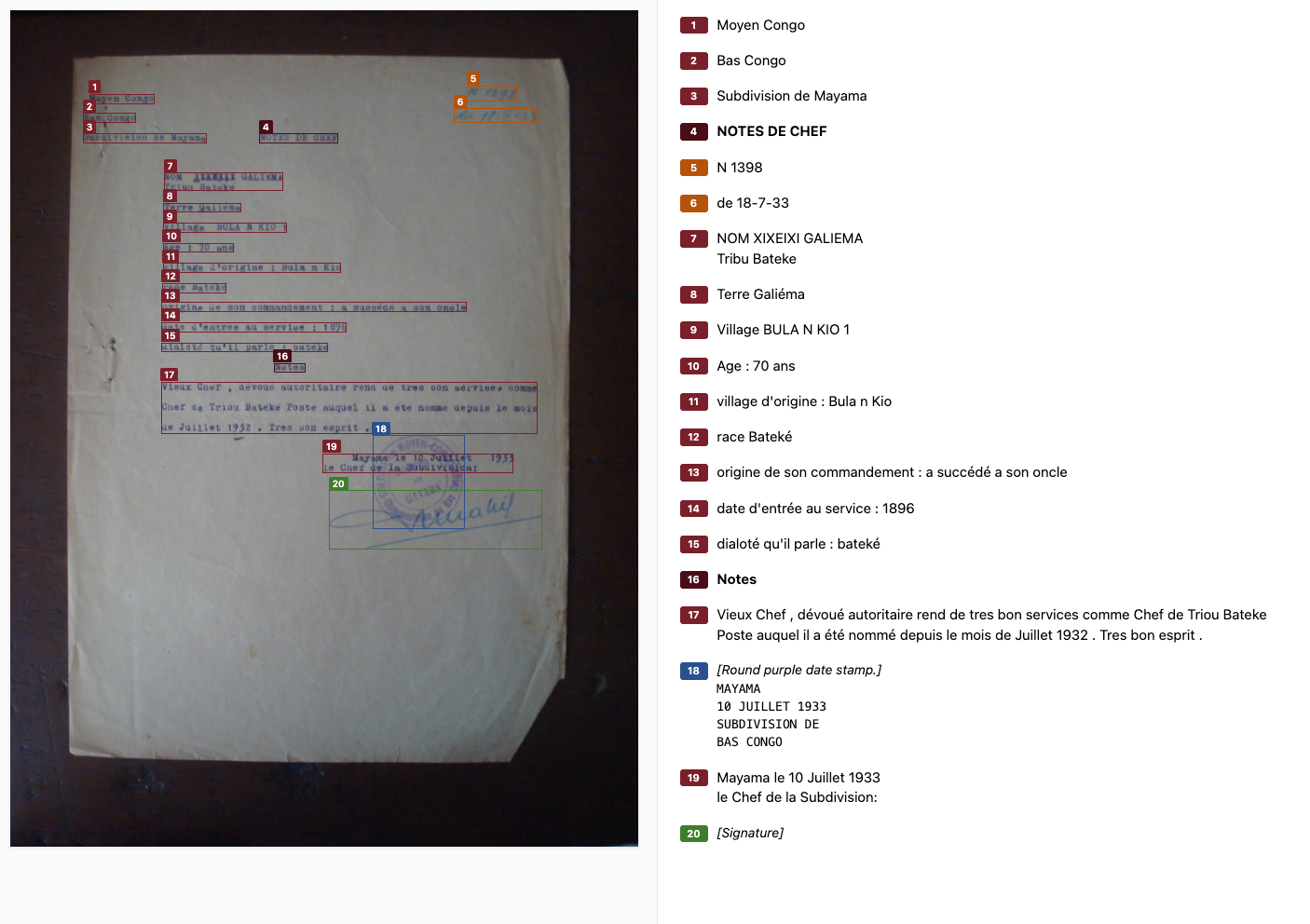
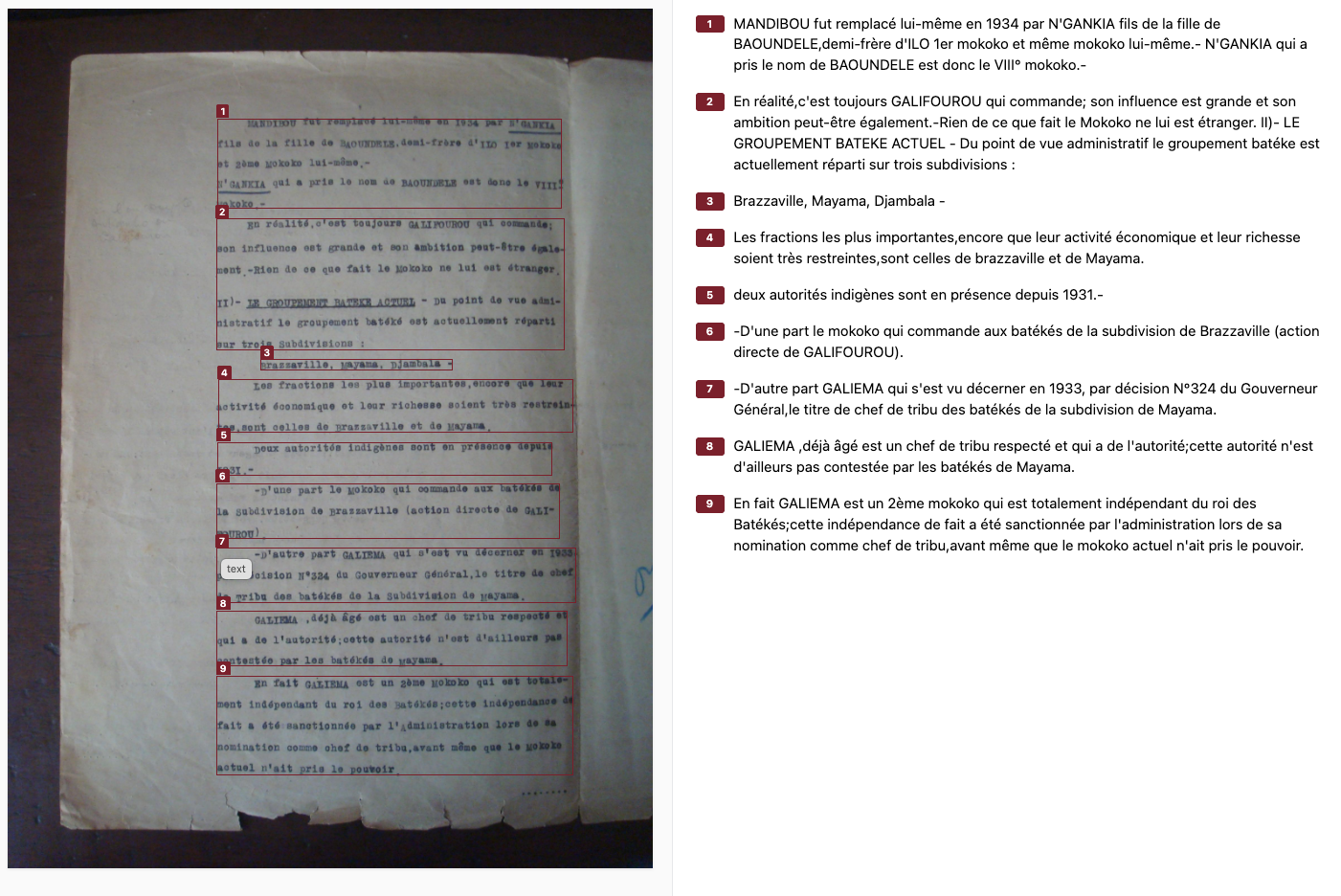
Beyond benchmarks, Soma-1X Lite is designed to handle the diversity and complexity of real-world documents, from historical administrative records to handwritten correspondence and structured scientific tables. The following examples illustrate how the model identifies document content, semantic elements and spatial structure across different document types.
Historical administrative records
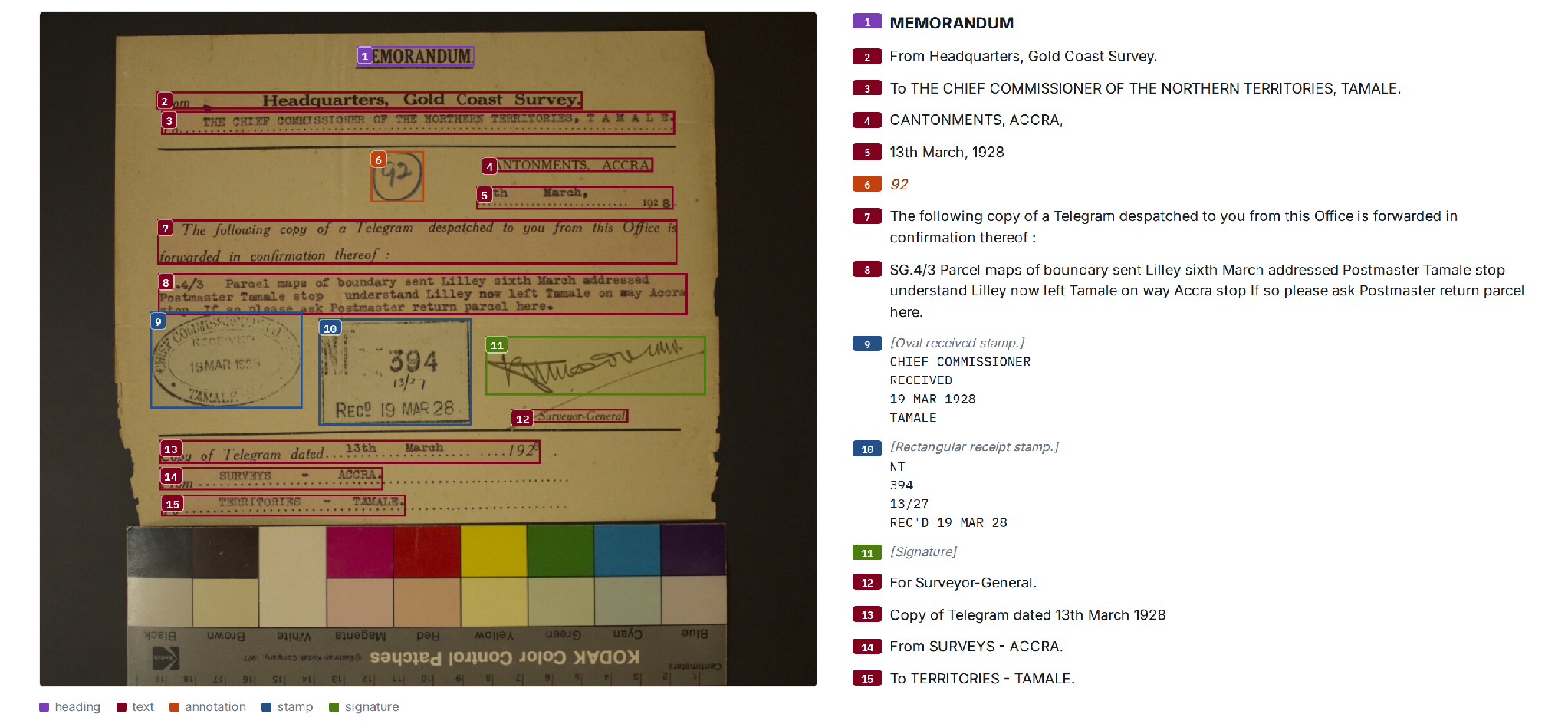
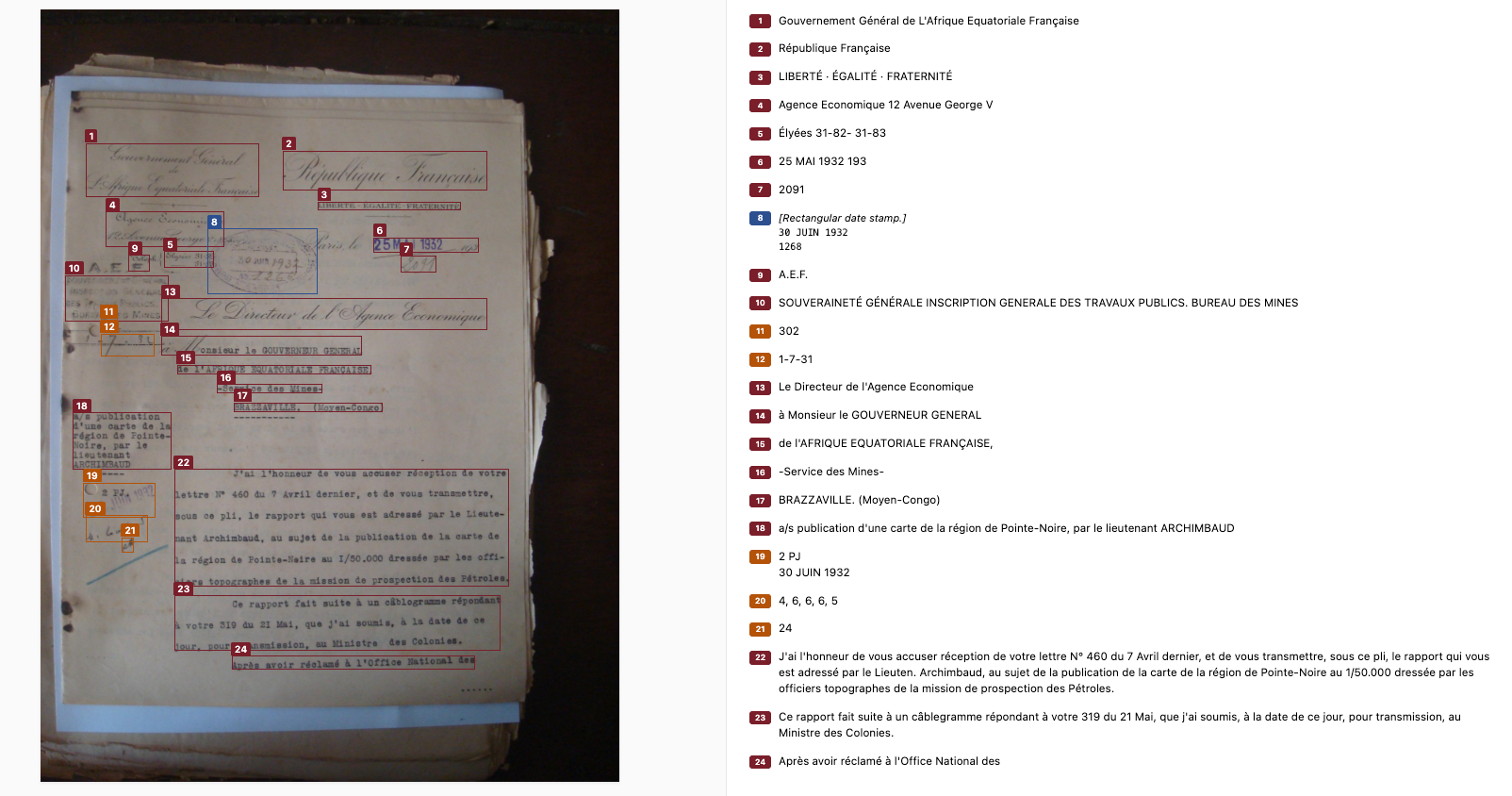
Gold Coast Survey, 1928
Soma-1X Lite reconstructs the document’s reading order and identifies typed text, handwritten annotations, stamps and signatures, preserving their positions within the original record.
Handwritten correspondence
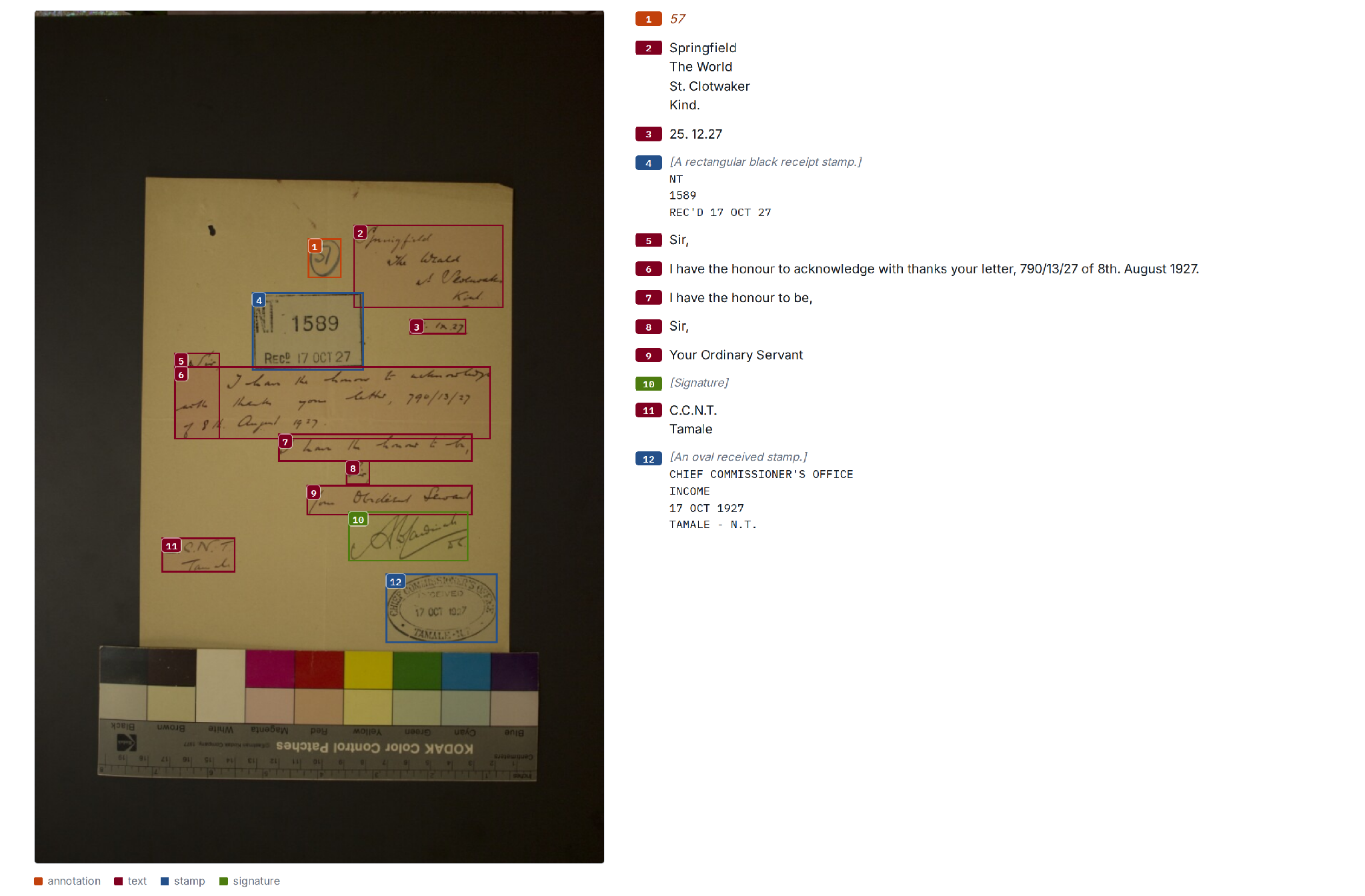
Government correspondence, 1927
Soma-1X Lite identifies handwritten text, administrative stamps and signatures, capturing both document content and its spatial organisation.
Historical scientific records
Belgian Congo weather record, 1969
Soma-1X Lite identifies a 46-row meteorological table alongside surrounding document elements, demonstrating its ability to process structured scientific records containing tabular data and handwritten entries.
What’s next
Soma-1X Lite is part of our broader effort to advance efficient, reliable document intelligence models. Our ongoing research focuses on three areas:
- Multilingual document understanding. Expanding language and script coverage while improving transcription fidelity across diverse writing systems, including languages underrepresented in existing benchmarks.
- Historical and degraded documents. Advancing recognition of handwritten, faded and low-quality records through targeted training and more comprehensive evaluation.
- Complex tables and forms. Improving structural understanding of multilevel headers, merged cells, handwritten entries and forms combining text with structured fields.
We are also actively refining Soma-1X Lite and will share updated, more capable versions as they become available.
Getting started
Soma-1X Lite is available on Hugging Face, alongside model weights, inference scripts, evaluation scripts and technical documentation.
Acknowledgements
Soma-1X Lite builds on Qwen3.5 and benefits from the work of the open-source AI and document intelligence research communities, including the teams behind olmOCR-Bench and OmniParse-Bench.
We also acknowledge the archivists, researchers, domain experts and institutional partners whose contributions and feedback have helped shape the development of Soma.
Examples Catalog

Blog